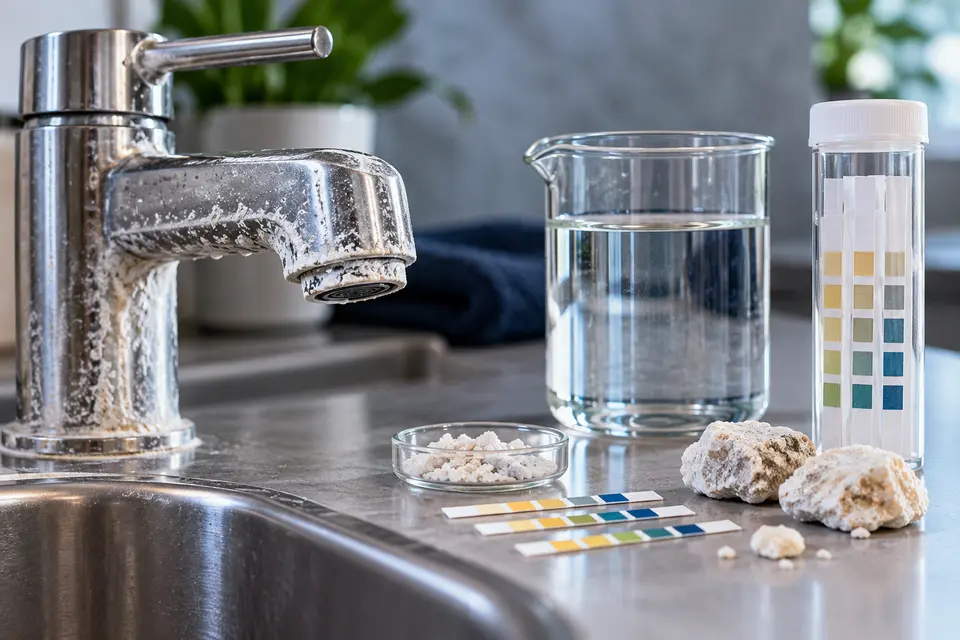
Water hardness and cleaning
Water is both a formulation input and a use condition and can significantly affect outcomes.
Read article
pH matters to performance, stability and compatibility, but does not define quality alone.
← Back to insights
pH matters to performance, stability and compatibility, but does not define quality alone.
pH describes acidity or alkalinity in an aqueous medium and can affect ingredient stability, surfaces and preservation. Suitable ranges differ for glass cleaners, hand washes and degreasers; no universal value fits every product. pH by itself cannot establish skin safety because other ingredients, concentration and use conditions also matter.
Calibrate the pH meter and use a documented method that specifies temperature and whether the sample is concentrated or diluted. Set formula-specific acceptance limits and monitor them in storage. If a reading falls outside range, check the instrument, sample history and addition sequence before correction. Safety directions depend on a complete hazard assessment.
Suppose laboratory and production pH values disagree. Check meter calibration, buffers, sample temperature and whether both operators measured concentrate or dilution. Repeat with a written method on representative samples. If the discrepancy persists, examine ingredient lots, addition order and batch history before any adjustment. This avoids unnecessary chemical correction caused by inconsistent measurement rather than a genuine product change.
Set an application-specific range, not a universal number.
Calibrate meters and follow a consistent method.
Review pack, surface and ingredient compatibility.
References for general scientific principles; they do not imply MS CHEM has performed tests or holds certifications.
 MS CHEM / 20
Water is both a formulation input and a use condition and can significantly affect outcomes.
Read article MS CHEM / 21
Thicker is not always better; flow, stability and dispensing matter.
Read article MS CHEM / 23
Foam can be desirable in one application and disruptive in another.
Read article